
HDFC was the top gainer in the Sensex pack, rallying over 7 per cent, followed by HCL Tech, M&M, HDFC Bank, Tata Steel, SBI, Bajaj Finance and Infosys. On the other hand, Axis Bank, Asian Paints, HUL, Titan and IndusInd Bank were among the laggards.

The rupee weakened to 62.58 against the US dollar in the early trade on Thursday.

The rupee ended lower by six paise at 65.73 against the US dollar on Monday.

'We have a plan to plough back a 'This year in the first half we had profits of more than Rs 31,000 crore.' significant amount of profits this financial year.' 'We have seen this organic plough back of profit is one of best ways to support the equity of the bank.'

As the global economy sways into uncertain territories and domestic prices almost certain to rise, Raghuram Rajan's ideas would have come in handy.

'Gold prices thrive on volatility and more so when the stock markets trend downward.'

Yes Bank was the biggest gainer in the Sensex pack, soaring 6.04 per cent, followed by IndusInd Bank, Tata Steel, HeroMotoCorp, Sun Pharma, Bajaj Auto, Power Grid, Tata Motors, SBI and Kotak Bank that gained up to 5.32 per cent.

Park is charged with one count of conspiracy to commit computer fraud and abuse and one count of conspiracy to commit wire fraud.
RBI's intention to keep its target inflation rate at 5% was the main reason behind keeping rates unchanged, says Adhil Shetty, CEO of BankBazaar.com.

The government will release the Index of Industrial Production for July 2015 on Friday, September 11, 2015.
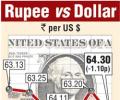
The local currency recovered some ground after the Reserve Bank of India (RBI) was said to have stepped in through state-run banks, helping the rupee to end at 64.30, a fall of 110 paise or 1.74 per cent.

There are two major factors behind the rupee fall - one is international and the other is domestic.

The currency fell 3.4 per cent this week, and is below the levels at which it was trading on July 15 when the Reserve Bank of India unveiled its cash tightening steps to defend the currency.

Among key stocks, Tata Motors, Hero MotoCorp, L&T, Wipro, ICICI Bank, Dr Reddy's Labs and ICICI Bank, all up between 1%-3%

The Indian rupee on Thursday appreciated by 12 paise to end at 66.71.

An escalation in the already simmering tensions between North and South Korea, China and Taiwan, and Russia and Ukraine could prove to be a bigger worry for the markets over the next few months rather than central bank policy action, said analysts. The markets, they said, are still not fully factoring in this possibility. "The conflict between Iran and Saudi Arabia is another geopolitical worry.

M&M led the gainers' pack, spurting 2.76 per cent, followed by ITC, Kotak Bank, L&T, SBI, Bajaj Auto and Nestle India.

The BSE mid-cap and small-cap indices ended flat against Sensex's 0.4% up-move.
Heavy unwinding by foreign portfolio investors and lacklustre equities dampened the sentiment

Monetary policy easing, coupled with the relaxation of lending rules and greater election-driven fiscal spending in the first quarter of 2019, will provide some support to growth during the first half of 2019-20 fiscal

RBI's tricky strategy to ease market's pre-Fed jitters.

Last year, the software giant launched a cloud adoption programme for SMBs.
.jpg)
The rupee was last at 62.05/06 after gaining to as high 61.9650 against the dollar, its highest since Nov 19. It had closed at 62.44/45 on Friday.

Rate-sensitive sectors like banks, auto and realty witnessed strong buying demand in trades today
Barack Obama is likely to pick a candidate to succeed Ben Bernanke sometime during the summer.
The apex bank's observation on Tuesday comes at a time when global markets remain uncertain about the overall impact of the tsunami and the subsequently unravelling nuclear crisis in Japan.
On speculative front as well, non-commercials have decreased bullish bets on COMEX silver futures and options to a three-month low.

HDFC was the top loser in the Sensex pack, shedding over 2 per cent, followed by Axis Bank, Bharti Airtel, M&M, Reliance Industries, ICICI Bank, IndusInd Bank and Titan.

After three consecutive years of infusing huge funds, foreign portfolio investors retreated from the Indian equity markets in a big way in 2022 with the highest-ever yearly net outflow of nearly Rs 1.21 lakh crore. The huge outflow, which surpasses by a big margin the previous record of Rs 53,000 crore net withdrawal in 2008, came amid aggressive rate hikes by central banks globally but 2023 is expected to be better on positivity about overall macroeconomic trends in India, experts said. Apart from global monetary tightening, volatile crude, rising commodity prices along with Russia and Ukraine conflict led to an exodus of foreign money in 2022.

In a dazzling resurgence, foreign investors have graced the Indian equity markets with an influx of nearly Rs 1.5 lakh crore in 2023, fuelled by optimism over the country's resilient economic fundamentals amid shadows of a gloomy global scenario. Experts believe that the positive trend may continue in 2024. This follows Indian equities witnessing the worst-ever net outflow of Rs 1.21 lakh crore by FPIs in 2022 on aggressive rate hikes by the central banks globally after net inflows for three consecutive years.

'Higher than expected inflation in the US or the European Union, faster than expected tightening by the major central banks, break out of a war in Europe, and withdrawal of portfolio equities from the emerging markets are factors which can result in equity market corrections.'
.jpg)
The partially convertible rupee closed at 63.37/38 per dollar compared with 62.83/84 on Monday. The unit dropped 0.85 per cent on the day, its biggest single-day fall in two weeks.

The rupee's gains came even as most emerging Asian currencies eased as the yuan fell beyond 6.20 to the dollar for the first time since April last year amid market speculation that the central bank will keep the currency weak as economic growth slows.

Domestic equities will be mainly driven by global market trends, foreign institutional investors' movement and developments around new Covid variant Omicron this week, according to analysts. Markets traded under pressure last week following weak global cues and overall investor sentiment remained downbeat throughout the week, they observed. "Global markets, Omicron variant, dollar index and FIIs' behaviour will be key factors to drive the market this week," said Santosh Meena, head of research, Swastika Investmart Ltd. One major event last week was US Federal Reserve's announcement that it will end bond-buying from March, and it also signalled starting rate hike cycle thereafter.

Reflecting nervousness over the prospect of the Federal Reserve tightening policy and event risk, traders stayed on the sidelines

Governor's statements will be weighed to gauge confidence level.
The biggest bullion-importing bank in India plans to team up with jewellers for the first time to offer a gold deposit scheme, hoping ease of access and attractive interest rates will tempt people to part with their jewellery and relieve tight supplies.
The 30-share BSE Sensex shed 0.9% or 186 points at 20,536 while the 50-unit NSE Nifty was off 1% or 61 points at 6,091.
Macro-economic data from China and minutes of the US Federal Reserve's last meeting caused the turmoil as stocks tumbled around the globe.

If the concerns over risking political capital are overcome, the long-term gains for the Indian economy will be immense, asserts A K Bhattacharya.
